

 Deutsch
 Korean
PCB Surfaces

Choose the right finish for reliable assemblies
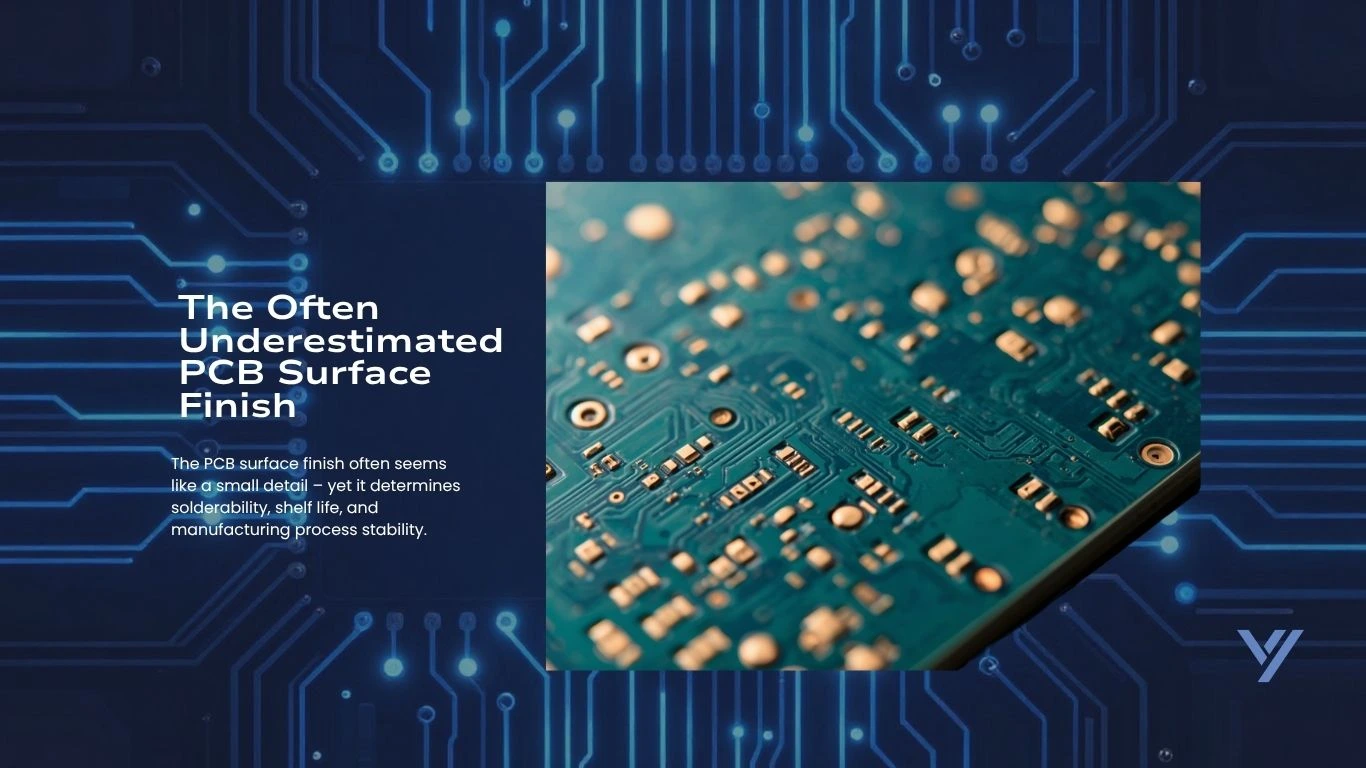
The surface finish plays a key role in determining the reliability of your printed circuit board – as it affects solderability, shelf life, the assembly process and the long-term functionality of the assembly. Anyone who selects HASL, ENIG, OSP, immersion silver or chemical tin based solely on unit price risks rework, scrap or subsequent in-the-field failures.
PCB surface finishes: How to choose the right finish for reliable assemblies
The right PCB surface finish is not merely a manufacturing specification, but a technical decision with a direct impact on quality, process reliability and total cost of ownership. It protects the exposed copper from oxidation and ensures that pads, through-holes and contact areas can be reliably processed during the subsequent soldering process. It is therefore worthwhile for designers, purchasers and EMS managers to evaluate the PCB surface finish as early as the layout, material selection and procurement strategy stages.
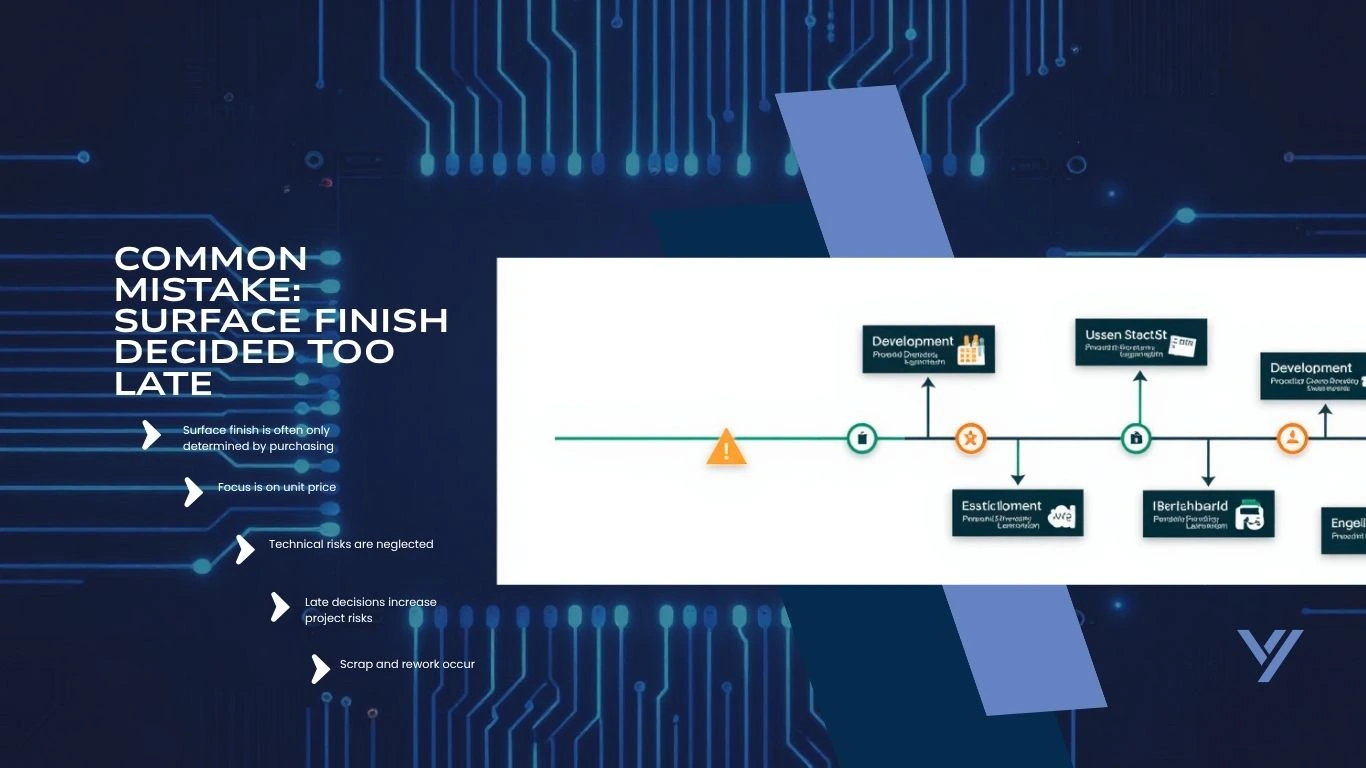
Why the PCB finish should be determined at an early stage
In many projects, the surface finish is carried over from previous assemblies or is only defined shortly before the order is placed. This can work as long as component technology, storage time, the reflow process and operating conditions remain comparable. However, as soon as fine-pitch components, BGA packages, HDI structures, multiple reflow cycles or demanding environments come into play, the choice of PCB finish becomes a significant risk factor.
A low-cost finish is only cost-effective if it is suited to the entire manufacturing and life cycle.
HASL, for example, is robust and cost-effective, but is not ideal for very fine pad geometries due to its lower planarity. ENIG offers high flatness, good storability and a wide range of applications, but incurs higher costs and requires controlled process management. OSP is highly planar and attractively priced, but is more sensitive to handling, storage and repeated thermal stress. The right choice therefore results from a combination of design requirements, assembly process, storage logistics and reliability targets.
Key criteria for selecting a PCB surface finish
To make a sound decision, technical and commercial criteria should be considered together. The decisive factor is not only whether a surface is fundamentally solderable, but how stably it can be processed under real-world conditions. Particularly in mass production, safety-critical electronics or global supply chains, even minor process deviations can result in significant follow-on costs.
- Component technology and flatness: Fine-pitch, QFN, BGA and HDI printed circuit boards require very flat surfaces such as ENIG, OSP, immersion silver or chemical tin, whilst simple THT designs often manage with HASL.
- Storage and process windows: Long storage periods, fluctuating climatic conditions or careless handling call for more robust finishes with good durability and clearly defined packaging requirements.
- Total cost and risk of failure: The lowest PCB price is not automatically the most cost-effective solution if it results in rework, delays, scrap or subsequent complaints.
Multiple reflow cycles, selective soldering, rework, contact areas, press-fit applications or RF properties should also be taken into account before placing an order. This helps to ensure that procurement, development and manufacturing do not each pursue different priorities, resulting in a finish that is ultimately not optimally suited to the assembly.
Correctly classifying typical surface finishes: HASL, ENIG, OSP and special finishes
HASL or lead-free HASL is particularly suitable for robust standard assemblies with larger pads and less critical coplanarity requirements. ENIG is regarded as a versatile solution for more complex printed circuit boards featuring fine-pitch, BGA, HDI or demanding SMT assembly. OSP offers low costs and excellent planarity, making it ideal for controlled, high-speed mass production processes. Immersion silver can offer advantages in HF and high-speed applications, but requires careful handling. Chemical tin is planar and of interest for certain press-fit or fine-pitch applications, but requires careful attention during storage and ageing. Hard gold, ENEPIG and EPIG are specialised solutions for contact wear, wire bonding, high-reliability applications or nickel-free HF designs.
EVYTRA’s recommendation:
Do not define the surface finish in isolation within the procurement department, but rather as part of the technical specification. Clarify at an early stage which components are to be mounted, how many reflow cycles are planned, how long the printed circuit boards will be stored, what environmental conditions will be encountered, and what costs a failure in the field would incur.
For simple industrial electronics, HASL may be a cost-effective option. For miniaturised, high-quality or process-critical assemblies, ENIG is often the safer standard choice. OSP, immersion silver, chemical tin, ENEPIG or EPIG should be used selectively when they better meet a specific technical requirement than a universal standard. In this way, the PCB finish becomes a predictable contributor to quality, delivery reliability and service life.
Would you like to ensure you choose the right PCB finish for your project?
EVYTRA helps you to integrate design requirements, PCB procurement, the assembly process and reliability targets at an early stage, so that your assembly can be manufactured consistently and function reliably in the long term.