

 Deutsch
 Korean
Capacitive buttons behind glass—how touchless operation works

The capacitive buttons
Capacitive buttons have become established in many modern control panels—especially where hygiene, design aesthetics, and robustness are required. Whether in medical technology, industrial plants, building automation, or public infrastructure, the ability to implement a touch-sensitive interface behind a closed glass surface offers enormous advantages. But how exactly does this work? And which design aspects are critical?
Functional principle of capacitive buttons
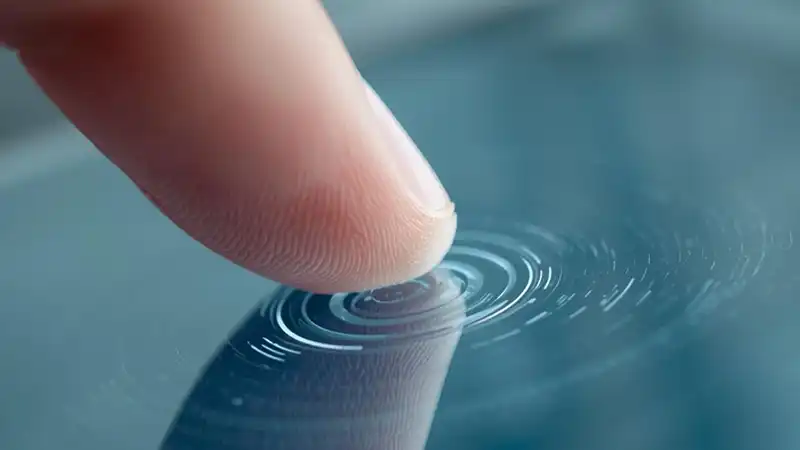
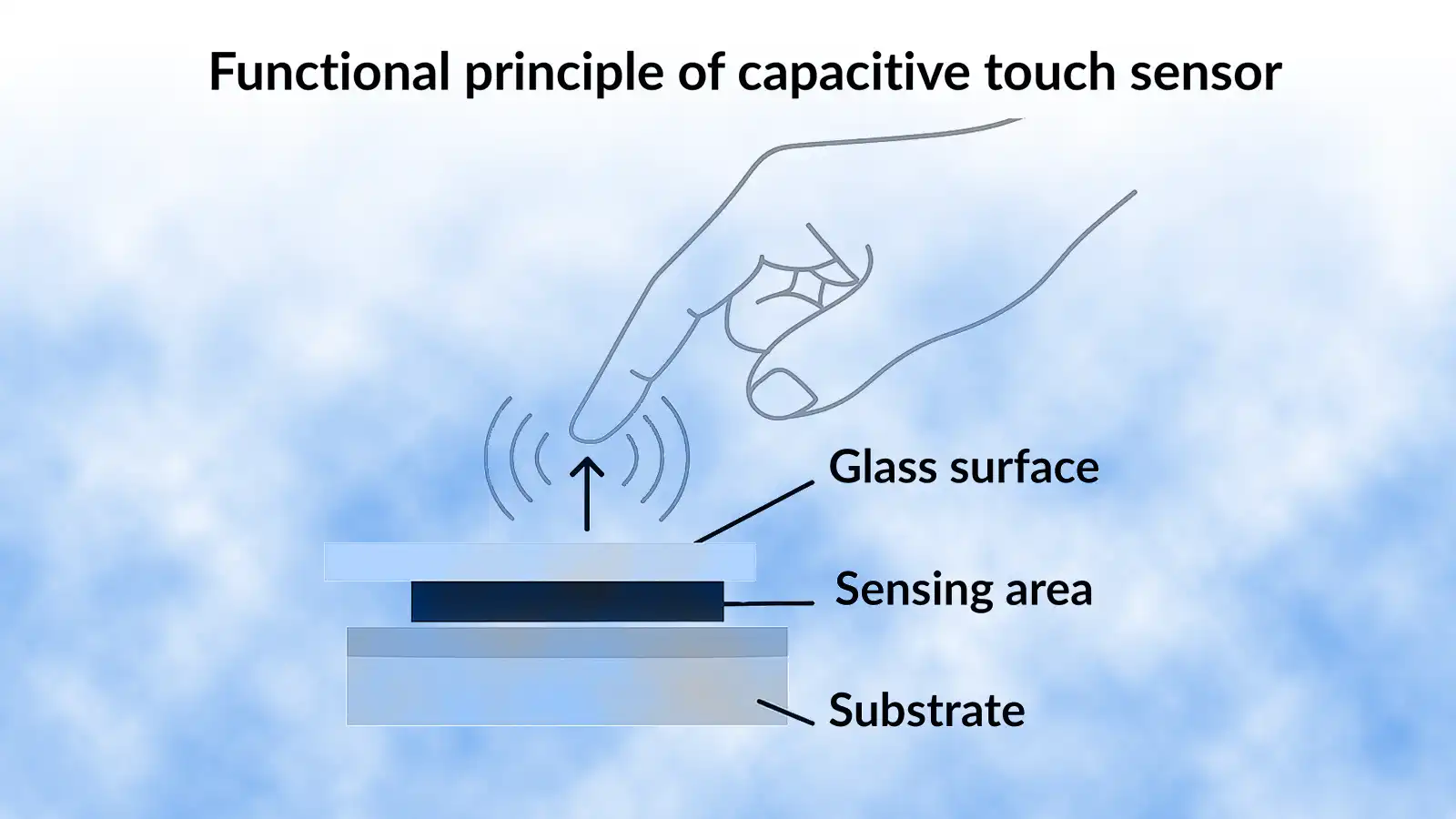
Capacitive buttons do not detect touch mechanically, but rather through changes in an electric field. The human body acts as an electrical conductor: when a finger approaches a surface, the local capacitance changes—this effect is measured and interpreted as button pressure.
The most important components and processes
- Sensor surface / electrode: A conductive surface (e.g., copper) on the printed circuit board. It generates an electric field and measures changes in capacitance.
- Glass or top layer: A non-conductive (dielectric) layer—often glass—protects the sensor plane and physically separates it from the finger..
- Capacitive measurement: The sensor surface generates an electric field. When a finger approaches, the capacity of this field changes..
- Controller / evaluation unit: A microcontroller continuously measures the capacitance values, analyzes deviations, and identifies valid touches..
- Signal processing / Filtering: Software algorithms filter out interference, suppress false alarms (e.g., caused by moisture), and generate a stable switching signal..
Schematic structure:
- Finger – approaches the surface
- Glass or top layer – protects the electronics and acts as an insulator
- Decorative film/printing – optional, for design and symbolism
- Sensor surface (copper pad/electrode) – on the printed circuit board
- Printed circuit board (PCB) – contains the sensors, wiring, and controller
- Controller/evaluation logic – interprets the changes in capacity
Advantages and areas of application
Capacitive buttons behind glass offer several interesting advantages, especially over conventional mechanical switches or membrane buttons:
- Contactless & non-contact – no moving parts, therefore less wear and tear
- Easy to clean / hygienic – ideal for medicine, the food industry, etc.
- Design freedom – glass surfaces look elegant and can be printed, textured, or illuminated
- Vandal-proof / robust – closed front protects electronics
- Integration behind different materials – depending on the technology, also behind films or non-conductive materials
Technical challenges & design notes
- Glass thickness / choice of material: The top layer (often glass) must not be too thick, otherwise the influence of finger contact on the sensor surface will be too weak. In practice, high-quality solutions use top layers in the range of approx. 1–4 mm.
- Distance and layout of the sensor surfaces: When keypads are positioned close together, precision is crucial to prevent crosstalk (interference between keys). Typical spacing ranges from 2–4 mm for glass surfaces..
- Protection against interference and environmental influences: Moisture, condensation, dirt, or conductive residues can cause unwanted changes in capacitance..
- Insulation & Shielding: Shielding electrodes reduce interference from housing elements or metal structures..
- Haptics and feedback: Since capacitive buttons do not provide mechanical feedback, some applications require haptic feedback (e.g., vibration)..
The EVYTRA solution:
Capacitive buttons behind glass combine elegance, robustness, and intuitive operation. They replace mechanical buttons in many modern applications, especially where hygiene, design, and durability are important. The key lies in the precise design of sensor surfaces, material selection, calibration, and software filtering.
EVYTRA offers everything from a single source—from glass processing and precision manufacturing to sensor and electronics integration. With in-depth expertise and tight manufacturing tolerances (>0.2 mm), we produce high-quality, reliable capacitive control panels.